
Spotting Reproduction Cartridges: A Practical Guide for Sellers
Authored by: Brandon Perton
For many people, the idea of a counterfeit game is hard to comprehend. Game Boy Advance Pokémon games have been frequently counterfeited for years. With some rare retro games now selling for hundreds or even thousands of dollars, it is easy for someone to create a counterfeit and sell it as the real thing.
Reproduction games are made to replicate original games, often for personal enjoyment, without the intent to deceive. Counterfeit games are produced to mimic original versions with the intent to mislead buyers into thinking they are purchasing a genuine product.
I suppose buying a reproduction cartridge of Nintendo 64 Clay Fighters Sculptures Cut at $30, is a lot cheaper than paying $1,500 for a genuine game. However, knowing how to spot a fake copy can save you $1,470 on Clay Fighters alone. In this situation, if you want to buy these games for your own personal collection, that’s fine. I draw the line when people buy these reproductions at $30 and try to resell the game as the real thing.
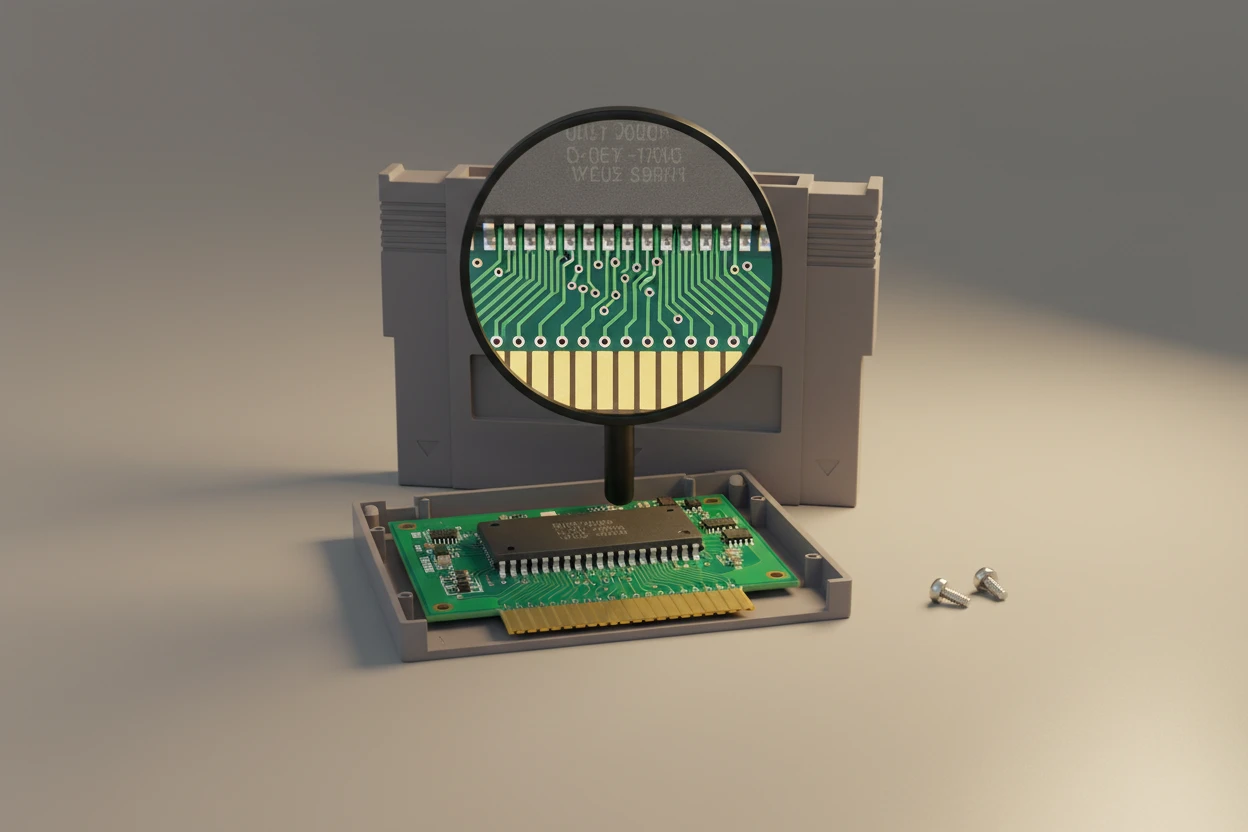
I’ve said it time and time again through my work at The Old School Game Vault: the easiest way to spot counterfeit cartridges is to open the game cartridge and examine the internal game board. However, before resorting to opening a game cartridge, try a few quick screening steps.
Start by checking the label for any inconsistencies, such as faded printing or incorrect fonts. Most retro Nintendo cartridges have a numbered imprint on the front or back label, like “A0” or “B23”. Most counterfeit games we see lack these numbers or markings.
Once you open the game, you’d specifically be looking for brand recognition to be stamped on the game board. If you’re inspecting a Nintendo game, does the internal board have ‘Nintendo’ stamped on it somewhere? If it’s a Sega or Atari game, does the internal board have its brand stamped on it? Or, in many cases for Sega Games, you will see the manufacturer’s name printed on the board. Like you’ll see “Namco” printed on the board if Namco was the publisher of that game.
Most game cartridges require a special screwdriver or game bit opener to open them. For the older Nintendo games, you’ll need a 3.8mm or 4.5mm game bit opener; these same game bits will work on most Sega cartridges. For Game Advance games, you’ll need a tri-wing screwdriver. All these accessories are easy to find on Amazon or eBay.
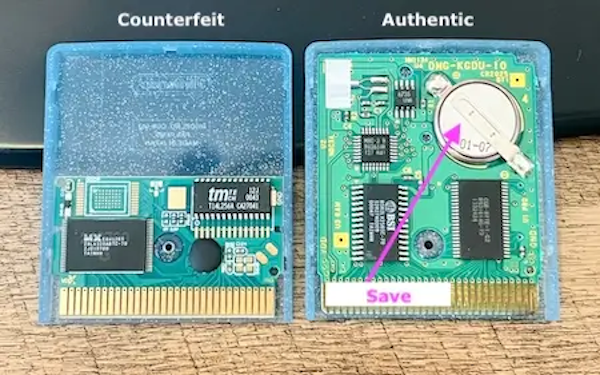
As an example, we received a fake Pokémon Crystal game cartridge the other day. For us, it was easy to spot the game as counterfeit: it looked almost brand-new at first glance, despite being 25 years old. Once we looked closer at the game, the color of the cartridge shell was a different shade of blue. The front label lacked any numbered imprints, and the Nintendo Seal of Quality was hard to read. Then we opened the game to be sure, and the game board was about half the size of a normal board. The first difference we noticed was that it lacked identification imprints and an internal battery, as an authentic copy would have.
Authored by: Brandon Perton founded The Old School Game Vault, a retro video game retailer established in 2008. He has extensive experience evaluating cartridge authenticity, condition, and resale value across multiple console generations.