
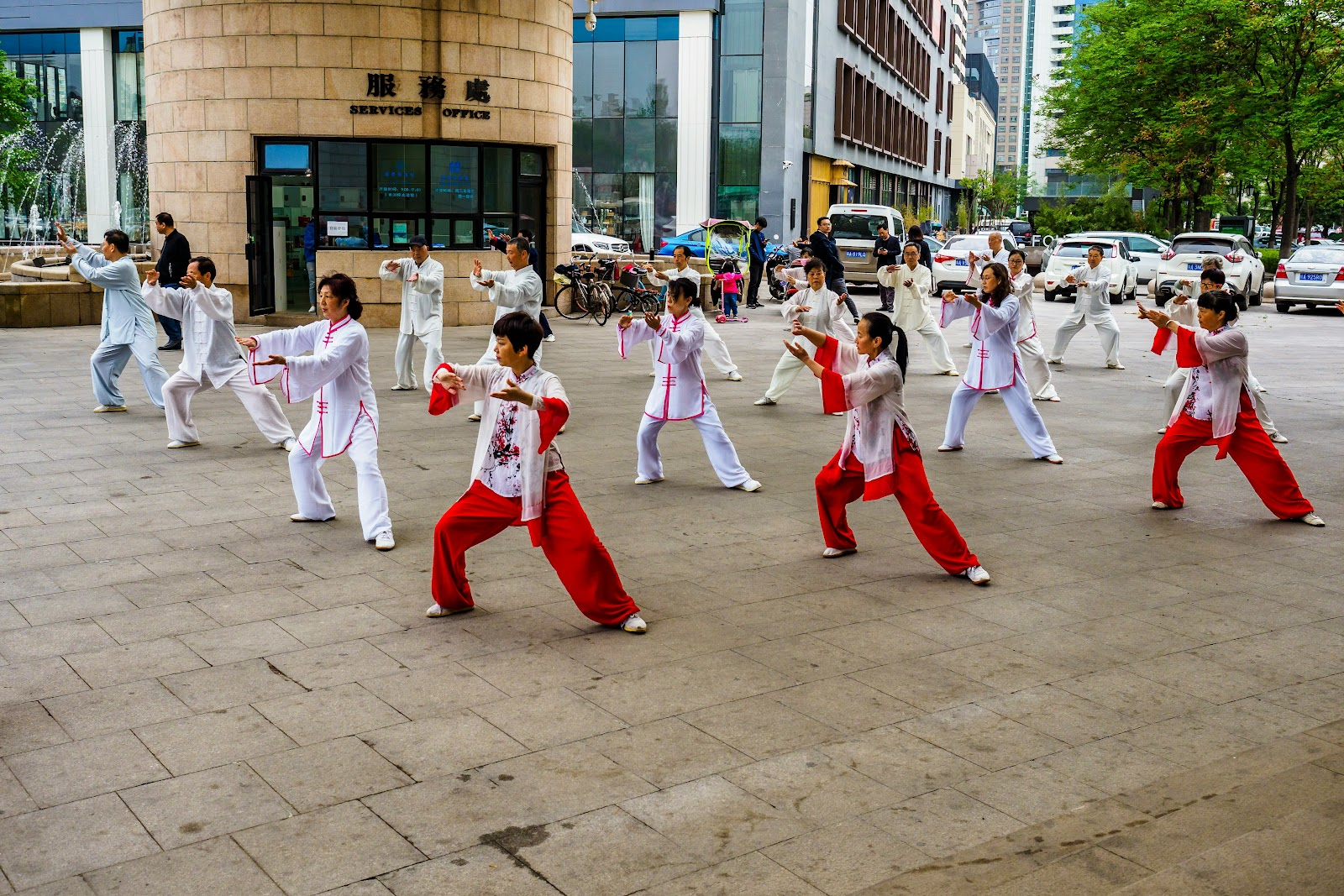
How Internal Martial Arts Can Be an Antidote to Modern Stress
Article by: Florin Gurbanescu
People show up to my classes feeling stiff or stressed. Often both.
Most are in their 40s and 50s, sitting at desks all day long, with the closest thing to physical activity being the commute to work and back. They’re looking for something, a change, but they’re quite not sure what.
Over the past six months, I’ve had more new signups than in the previous two years combined. Searches for Tai Chi courses jumped 260% compared to last year.
This is what I think is happening: all the technological progress that helps us do more and faster, is the same thing that’s making us more stressed and more disconnected from our bodies.
People are realizing something’s off, so they’re searching for ways to slow down.
I stumbled across internal practices when I was 20. I didn’t understand much at the time, but I kept at them alongside my regular martial arts training. And they became my anchor whenever things got difficult.
At 23, a knee injury forced me to stop my regular training for one year and Tai Chi and Qigong were the only practices I could still do. They didn’t just keep me balanced, they actually sped up my recovery.
So I’d like to share some insights into some of the basic principles from the internal martial art I practice and teach – Taijiquan.
My hope is that this won’t be just information – we have plenty of that. My hope is that you’ll take whatever bits sound true to you and integrate it into your own physical practice, or even day-to-day activities like doing the dishes or driving your car.
Start With How You Stand
Last week, on the subway, I watched a group of teenagers folded over their phones. When they stood up, their upper backs were still visibly rounded – the shape had become default.
And this isn’t a cosmetic issue. How we hold our bodies affects everything: back pain, obviously, but also headaches, eye strain, digestive problems from compressed organs, even how well we breathe.
That’s why in Taijiquan we start by fixing alignment. First when you’re standing still, then when you’re moving.
When your alignment is off, you’re putting unnecessary pressure on joints, creating muscle tension in places that shouldn’t be tense, setting yourself up for problems down the line.
But here’s the thing – most people don’t realize their alignment is off. They’ve been standing and moving a certain way for years, maybe decades. It feels normal because it’s familiar.
Try this: Stand up for a moment, legs shoulder-width apart. Keep your head upward, as if suspended from the crown, chin tucked in, and let the rest of the body melt down – without dropping the head. Do you feel the back of the neck lengthening? Can you feel your shoulders relaxing down? Any other details?
Learning to Feel Your Body
A lot of the new students coming to my classes have a hard time sensing what’s going on in their bodies.
They can feel the strong sensations – like pain or pressure from a push – but they don’t notice more subtle things: that they’re unknowingly leaning backwards when trying to stand still. Or that the head is tilting to one side. Or one shoulder is holding more tension than the other.
But as they keep practicing, they begin to register more and more subtle nuances and differences.
In scientific terms, this skill would be a combination of interoception (sensing what’s happening inside your body) and proprioception (knowing where your body is in space). But the label matters less than developing the skill.
And we do that gradually.
At first, you might notice just a pain in the shoulder. That’s perfectly fine. As you keep practicing, you start noticing more details. The jaw is clenched. The stomach is tight. The shoulders are creeping up toward the ears. You’re holding your breath without realizing it.
Try this: Without adjusting anything, just notice – where exactly do you feel tension in your body? Is your jaw clenched right now? Are your shoulders up?
Most people discover at least one thing they weren’t aware of.
When you’re moving, there are even more details to notice. How the weight shifts from one leg to the other. How stepping by pushing the back leg feels different from stepping by sinking into the front leg. How the spine can lengthen when you’re extending an arm.
With each detail you catch, you’re strengthening the connection to your body.
I remember a student in her 30s who got genuinely excited when she realized she could actually change something in her body. She’d noticed one shoulder sat higher than the other; she could feel it tensed up, sometimes even painful, but she couldn’t get it to relax down. Her body had held that contraction for so long it didn’t know how to let go anymore.
She kept working at it – noticing the tension, trying to release it. Three months into the practice, while doing one of the exercises, her shoulder suddenly dropped down to match the other one. Ten seconds later it crept back up, but something had shifted. Her body rediscovered the pathway to relaxation.
This is a great feeling, like you’ve discovered a superpower. Yet it’s something quite natural: just body awareness plus knowing how to release tension on purpose.
Relaxation Is More Than Collapsing on the Couch
After a hard day at work, we think relaxation means getting home and collapsing on the couch. And this can feel relaxing, but with the price of disconnection: mind zones out and the body is abandoned. We only remember about it when something starts hurting.
In Taijiquan, relaxation is understood differently. You maintain good structure – spine aligned, body segments connected – and let all soft tissue drop with gravity. You keep your mind connected to your body, scan for tension, and release it. Shoulders are up? You let them drop. A hip is holding tension? You release it. Your jaw is clenched? You soften it.
It’s similar to body scan meditation, with two key differences:
1) You don’t just notice tension, you consciously release it
2) You do this while moving, not just standing still – which requires a higher level of awareness
Try this: Stand for a moment with your arms at your sides. Now lift your shoulders up toward your ears, hold for three seconds, then let them drop completely. That’s active release – not just noticing tension, but consciously letting it go. Now try to release your shoulders without tensing them first, and while moving your arm in different positions. More difficult, right?
How Stretching Deepens Relaxation
If we were completely relaxed all the time, our muscles would atrophy. We need some tension to stay functional. But tension doesn’t mean contraction – and this is where most people get confused.
Think of the rubber band on a slingshot. The power comes from stretching it, not pushing it. The more you stretch it (without breaking it), the more potential energy you create, the farther the projectile flies. If the rubber band were contracted, tied in a knot, stiff – it wouldn’t do anything.
Similarly, in Taijiquan we stretch the muscles without forcing them into the stretch, and then we let go of the tension created by that lengthening. The deeper the stretch – and the less force we use – the deeper the release that follows. The key is less force: nothing is pushed or pulled. The stretch needs to be as passive as possible.
Try this: Push your hands upward until they are fully extended – as if you’re pushing against the ceiling. Now let them drop. Then extend them upwards again, but this time like you’ve just woken up and you’re stretching. Feel the difference? The second time, your arm muscles extend more and contract less.
The effects on your body are significant. Physiologically, eliminating contraction restores blood and lymph flow – oxygen reaches your tissues better, nutrients move freely. Neurologically, slow stretches – especially in the neck and shoulders – activate the vagus nerve, which shifts your nervous system from fight-or-flight into rest-and-digest mode. From a traditional medicine point of view, you’re clearing energy blocks in your meridians.
Pick whichever explanation you prefer. What matters more are the results and the steps to get there.
Do You Actually Need Tai Chi?
Tai Chi is a complex system with a clear pathway for connecting your mind and body. And these are just some of the basic principles of Tai Chi and how they can generate transformation.
But Tai Chi is not the only practice that can help us rebalance and connect with our bodies.
This is what I tell every new student: You don’t need to do Tai Chi if that’s not your thing. Do yoga, or dance, or swim. Any physical activity you genuinely enjoy will improve your health, physical and mental – more than a “perfect” practice you dislike. If you hate it, you won’t stick to it.
The key is conscious awareness and consistency. If you can bring attention to your body while you move and make it a regular habit, you’re already making real change.
The world isn’t slowing down. The technology isn’t going away. But we can learn to move through it differently – more connected and more aware.
—–
Author: Florin Gurbanescu is Head Coach of the Romanian Wushu Taolu Team and founder of Wushu Kinetics. He holds degrees in Physical Education and Sports and Psychomotricity, and has been practicing martial arts for 35 years. He now focuses on teaching and practicing internal martial arts.